Statue of the god Vishnu outside the palace of Patan, Nepal
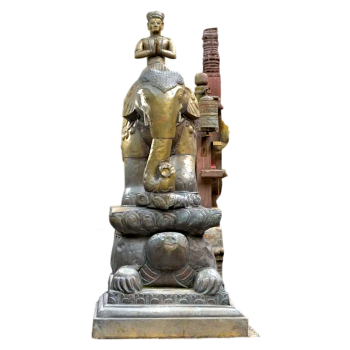
Statue of the god Vishnu outside the palace of Patan, Nepal

The statue is located outside the Patan Durbar Palace in Nepal. This statue was set up by the Mara kings because they were faithful followers of the god Vishnu.
Nepal Kathmandu Golden Monastery Buddha riding an elephant
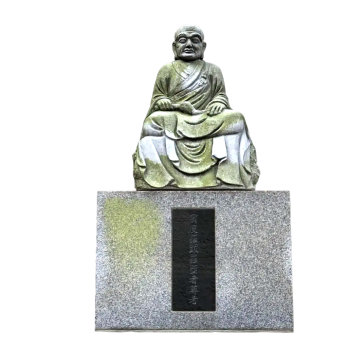
Nepal Kathmandu Golden Monastery Buddha riding an elephant

This Buddha statue is located in the largest temple in Kathmandu, Nepal-Hiranya Varna Mahavihar (Golden Monastery). The temple is named "Golden Temple" because all its statues and buildings are painted in gold ". It is very unique, not only because of its large scale, but also because of the three-story golden pagoda of "Shakyamuni Buddha", which is said to have been built by the 12th century king Bhaskar Varman.
Buddhist Cultural Heritage BINDROO BACHROA

Buddhist Cultural Heritage BINDROO BACHROA

Bindu Luo Duoza (Pindola Bharadvaja) is an arhat in Buddhism. According to the earliest Buddhist scriptures in India, Bindu Rojama was one of the four arhats who the Buddha asked to remain on earth to promote the Dharma. Each of the four arhats corresponds to the four directions. Binduro is known for his mastery of occult and supernatural powers. Together with Ananda, he preached to women twice in the palace of Yutuoyan in Sami. In later centuries, the number of arhats increased from four to sixteen and eventually to eighteen. In Tibetan thangka paintings, Binduo Luo Luoga usually hands
Nepalese cultural heritage meditation wise man

Nepalese cultural heritage meditation wise man

Statue of the wise man in meditation located at Durbar Square in Kathmandu, a statue of cultural heritage from the 18th century history of Nepal.
Indian marble temple pillars

Indian marble temple pillars

Indian marble temple pillars are from Jain temples in India. It is now located at the British Museum in London. Production and twelfth century.
【 Wood Carving 】 Avalokitesvara Bodhisattva (3D printable)

【 Wood Carving 】 Avalokitesvara Bodhisattva (3D printable)

Avalokitesvara Bodhisattva, also known as Avalokite ś vara in Sanskrit, is a transliteration of the Sanskrit word Avalokite ś vara. It is also translated as "Avalokitesvara" or "Avalokitesvara" and transliterated as "Avalokitesvara" or "Avalokitesvara". Amitabha Buddha's left attendant, one of the "Three Saints of the West". Buddhism believes that Avalokitesvara Bodhisattva is a compassionate and benevolent bodhisattva. When suffering beings recite his name, the Bodhisattva immediately observes his voice and goes to save and liberate them, hence the name. During the Tang Dynasty, due to the taboo of using the name of Emperor Taizong Li Shimin, the character "shi" was removed and he was briefly referred to as "Guanyin".
Shuiyue Guanyin

Shuiyue Guanyin

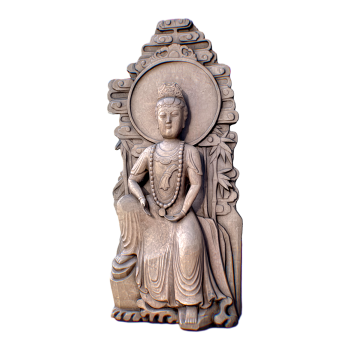
Shuiyue Guanyin, also known as Water Auspicious Guanyin or Water Auspicious Bodhisattva, is the corresponding incarnation of Guanyin's thirty-three phases of observing water with one heart. The name 'Shuiyue' is not derived from early Buddhist scriptures, but rather from the fusion of Buddhism with local culture after it was introduced to China. There are different theories about the origin of Shuiyue Guanyin, but it is currently unanimously believed to be related to the mid Tang painter Zhou Fang. According to Xuanzang's "Records of the Western Regions of the Great Tang Dynasty", Zhou Fang created the body of Guanzi Bodhisattva in the Bu'luojia Mountain, which is described as "a marvelous creation of water and moon". This painting depicts a full moon surrounding Guanyin, surrounded by a bamboo forest. Since the Tang Dynasty, the image of Shuiyue Guanyin has been constantly evolving, and its sitting posture has also undergone several changes.
The sitting statue of Shakyamuni Buddha during the Guishuang Empire period

The sitting statue of Shakyamuni Buddha during the Guishuang Empire period

The Kushan Empire was an ancient prosperous country that existed in Central and South Asia. During its peak period (105-250 AD), its territory extended from present-day Tajikistan to the Caspian Sea, Afghanistan, and the Ganges River basin. Guishuang is a branch of the Dayue people who lived in the Amu Darya and Syr Darya river basins in the 2nd century BC. In 130 BC, the Yue people migrated south to conquer Daxia and divided it into five tribes, each with a chief called the Marquis of Xi. The Guishuang Xiahou Qiu, one of the Five Xiahou, eliminated the other Xiahou, unified the five tribes, and established the Guishuang Kingdom. However, Qiu defeated Anxi and attacked the Kabul River Basin and Kashmir region southward, eventually establishing the capital as Gaofu.
Shale statue of Shakyamuni half body from Peshawar, Pakistan in the third century

Shale statue of Shakyamuni half body from Peshawar, Pakistan in the third century

The half body statue of Buddha, made of shale in the 2nd and 3rd centuries, originated from Peshawar and is currently housed in the National Museum of Pakistan. Shakyamuni was like turning a wheel with both hands, wearing a huge bun on his head. He has regular facial features, a high nose, deep eyes, and a small beard on his lips. Wearing a robe with exposed right shoulder, the folds are very smooth. Strong in physique, it is the pinnacle of the Jiandala statue.
Gandara relief sculpture

Gandara relief sculpture

This is a Gandhara relief depicting a person riding between the two humps of a camel, holding a sacred object in both hands, with a solemn and sorrowful expression. The person in front turned around to look at the artifact, with the same serious expression on their face. This relief is from the Swat region in the third century AD and is made of gneiss. Gandara art is a Buddhist art form from the Gandara region in the northwest of the Indian subcontinent (now eastern Pakistan and Afghanistan), which reached its peak around the 1st century BC to the 5th century AD.
Ming Dynasty gilded bronze Buddha statue of Medicine Buddha

Ming Dynasty gilded bronze Buddha statue of Medicine Buddha

This Buddha statue is currently housed in the Santa Barbara Museum of Art in the United States. This Medicine Buddha statue can be traced back to the Ming Dynasty in the 16th or 17th century and was auctioned at Christie's in Paris in 2022.
Maitreya Buddha Stele

Maitreya Buddha Stele

This is an artwork created in 563 AD and is currently housed in the Minneapolis Museum of Art in the United States. Although this work is relatively small in scale, its exquisite carvings showcase the complete image found on larger Buddha statues. In addition to the Maitreya statue in the center, the engraved halo, and the bodhisattvas on both sides, flying heavens and dragons also appear on the flame shaped mandalas at the top and bottom. The back of the stone tablet is engraved with a 69 character inscription, which records the name of the donor who commissioned the production of this work and dedicated it in 563.
The stone carved Buddha statue on the pagoda is located in Kathmandu, Nepal

The stone carved Buddha statue on the pagoda is located in Kathmandu, Nepal

The four Buddha statues carved on the pagoda are located in a temple in the Swayambunat complex in Kathmandu, the capital of Nepal, and were built in the 16th century. The architectural complex of Swayambunat includes a pagoda, various temples and shrines, as well as Tibetan monasteries, museums, and libraries.
Shanru Dragon King Stone Statue

Shanru Dragon King Stone Statue

Shanru Dragon King, also known as Shannu Dragon King, is one of the eight Dragon Kings in Japanese mythology - Rain God Dragon. According to legend, the monk Konghai brought about the appearance of the benevolent Dragon King during a famous rain seeking competition in 824 AD. This statue is located at Longquan Temple on Mount Daifeng in Japan.
Buddhist Gatekeeper Stone Statue

Buddhist Gatekeeper Stone Statue

The statue of the gatekeeper god from the 8th century is now housed in the Minneapolis Museum of Art in the United States. This type of statue is usually located at the entrance of Buddhist cave sanctuaries and temple complexes, with the purpose of obstructing any forces opposing Buddhist thought. Therefore, they are vividly depicted as energetic postures, threatening facial expressions, exaggerated muscle structures, and ready to face all threats. The basic posture of this rare Tang Dynasty work, with its surrealism and complete plasticity, represents a style that had a huge impact on the Buddhist guardian image carved during the Kamakura period in Japan (1185-1333).
Bodhidharma statue

Bodhidharma statue

Bodhidharma was a Buddhist monk who lived in the 5th or 6th century. Traditionally, he is considered the successor of Zen Buddhism to China and is regarded as the first patriarch of China. According to Chinese legend, he also began physical training for Shaolin monks, leading to the birth of Shaolin Kung Fu. In Japan, he is called Damo. Regarding the artistic depiction of Bodhidharma, he is depicted in Buddhist art as a non Chinese with a hot temper, thick beard, and wide eyes. He is referred to as' blue eyed Hu 'in Zen texts.
Buddha's seated statue from the 2nd to 3rd century AD

Buddha's seated statue from the 2nd to 3rd century AD

This Buddha statue may have been made in the Gandhara region (now Pakistan) in the 2nd to 3rd century AD. The height of this Buddha statue is 95 centimeters, the width is 53 centimeters, and the diameter is 24 centimeters. This Buddha statue depicts the Buddha sitting and preaching. The Buddha's gesture is very special. This gesture, also known as the clay jar or the Dharma wheel, reveals that the Buddha is telling a sermon, explaining the four noble truths of human existence and the path to enlightenment. This statue is currently located in the British Museum.
Amitabha Buddha statue

Amitabha Buddha statue

This statue was originally located in Hancui Village, Hebei Province, northern China. According to the inscription on the pedestal of the statue, it was enshrined for Chongguang Temple in 585 AD. This statue was created by art merchant C T. Loo donated it to the Chinese government, and in 1938, the Chinese government gave it as a gift to the British Museum to commemorate the Chinese art exhibition held in London from 1935 to 1936 This Amitabha Buddha statue is about 6 meters high and is the largest ancient Chinese statue in the West
Buddha Head Statue

Buddha Head Statue

This Buddha head is a work from the 2nd to 3rd century AD, originating from the ancient Indian state of Dhara (now Pakistan), made of gray gneiss, with dimensions of 27.8 × 16.4 × 19.6 centimeters. It is currently preserved at the Art Institute of Chicago.
Sitting Statues of Sakyamuni Buddha in the Period of the Imperial Empire of Gui Shuang

Sitting Statues of Sakyamuni Buddha in the Period of the Imperial Empire of Gui Shuang

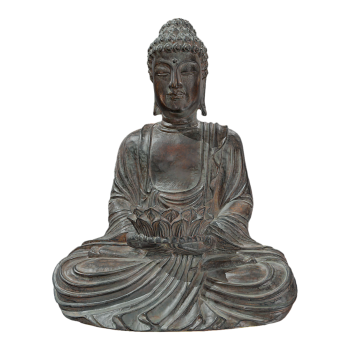
The statue depicts the image of Buddha Sakyamuni in a state of enlightenment, sitting in a meditative posture. This statue is probably an early Buddha found by the site of Jamal Garry in the ancient Gandhara region of modern Pakistan during the Kisam Empire, during the 2-3rd century AD.